
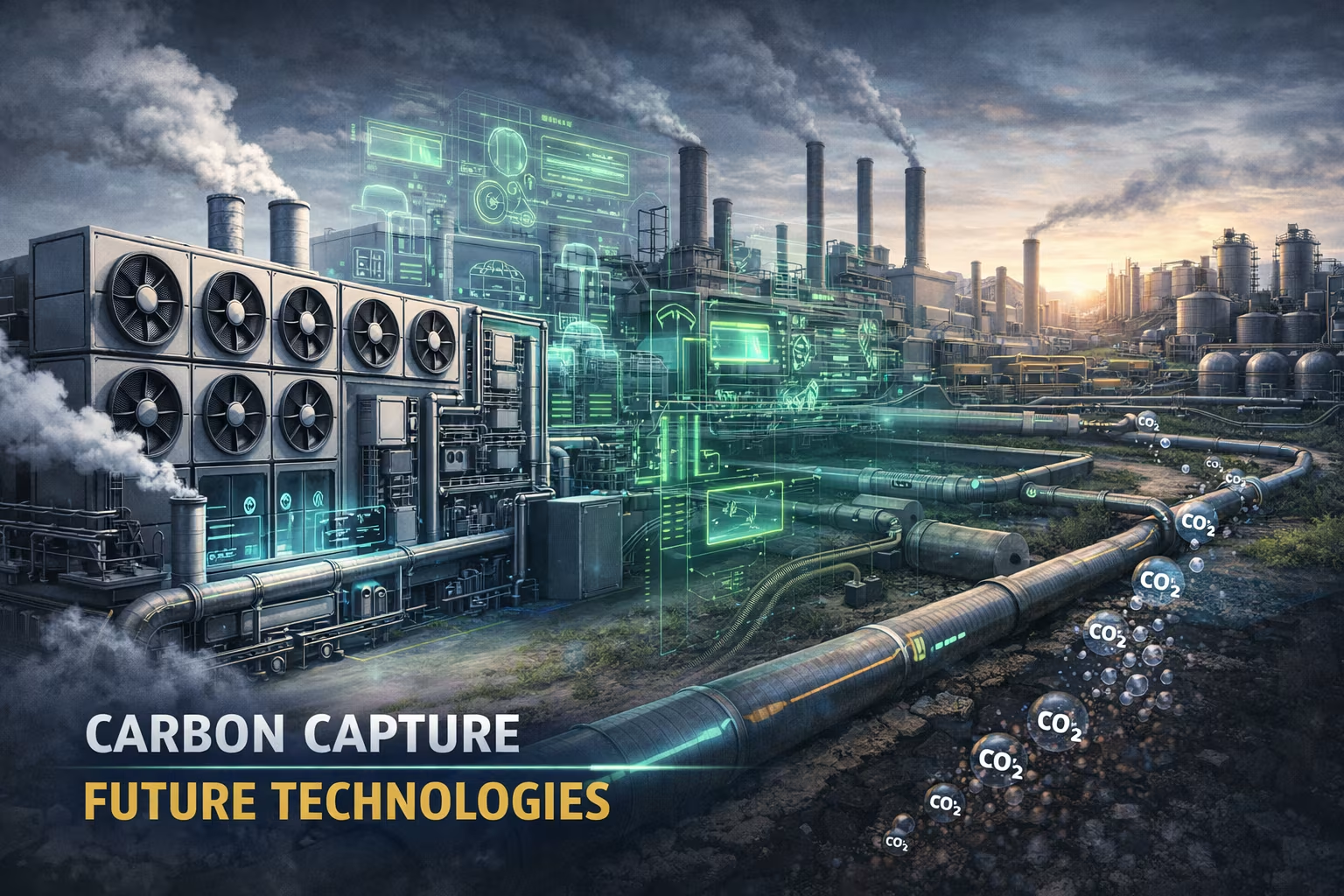
Carbon Capture Future Technologies: What Is Coming and What It Means for Indian Industry
The carbon capture technology landscape is advancing faster than most industrial operators realise. Innovations that were laboratory demonstrations five years ago are approaching commercial deployment today, and they will fundamentally reshape the economics of carbon capture for Indian industry over the coming decade.
For the comprehensive strategic context, refer to our Carbon Capture Technology Guide.
Next-Generation Solvent Chemistry
The largest operating cost in conventional post-combustion amine scrubbing systems is the energy required for solvent regeneration. Second-generation solvent formulations are addressing this directly:
- Ionic liquids offering lower vapour pressure and reduced degradation
- Phase-change solvents that absorb CO2 as a liquid and release it as a precipitate, reducing regeneration energy by 30-50%
- Advanced amine blends optimised for lower regeneration temperature
- Several of these technologies are in demonstration plant operation internationally and approaching commercial deployment
Solid Sorbent Systems: Approaching Commercial Scale
Solid sorbent capture systems - which adsorb CO2 onto solid materials rather than absorbing it into liquid solvents - offer the potential for lower energy regeneration and simpler handling. Multiple technologies are progressing through demonstration to early commercial deployment, with several targeted specifically at industrial flue gas streams.
For Indian industrial deployments today, solid sorbent systems carry higher technology risk than proven amine systems. Over the next 3-5 years, as commercial track records develop, they will become increasingly competitive for a broader range of applications.
Direct Air Capture: The Long-Term Horizon
Direct Air Capture (DAC) - extracting CO2 from ambient air rather than concentrated point-source emissions - is progressing from laboratory to early commercial scale internationally. Current costs of $300-600 per tonne make DAC uneconomical for most industrial applications today. However, cost reduction trajectories suggest DAC may approach $100 per tonne by the mid-2030s - at which point it will open new carbon credit market opportunities for facilities that develop the operational infrastructure early.
Carbon Utilisation: Beyond Storage
Carbon utilisation - converting captured CO2 into valuable products - is expanding the commercial pathways available to industrial facilities:
- Enhanced concrete curing - improving compressive strength and reducing cement content
- Industrial gas supply - food-grade CO2 for beverage and refrigeration industries
- Dry ice production for cold chain applications
- E-fuel synthesis using green hydrogen and captured CO2
- Emerging applications in building materials and chemical feedstocks
For Indian facilities located near industrial CO2 off-take markets, utilisation pathways can substantially improve overall project economics by eliminating storage costs and generating direct product revenue.
Digitalisation and AI-Optimised Capture
Digital optimisation of carbon capture operations is improving capture efficiency and reducing operating costs in deployed systems:
- Predictive maintenance algorithms reduce unplanned downtime
- Real-time capture rate optimisation maximises carbon credit generation from available system capacity
- Data analytics applied to CEMS output improves verification record quality and reduces audit friction
- Remote monitoring platforms enable expert oversight without on-site staffing requirements
For current technology comparison, see carbon capture technology comparison. Market dynamics driving technology development are in carbon capture market trends. For startup ecosystem developments, see carbon capture startup landscape. For the broader industry sustainability trajectory, see our guide on the Future of Industrial Sustainability.
Conclusion
Technology evolution is consistently improving the economics of carbon capture. Facilities that deploy current-generation systems today are not locked into obsolescence - modular design and infrastructure compatibility with next-generation solvents allow staged upgrades as better technologies become available. The full technology landscape is in our Carbon Capture Technology Guide. Current technology comparison is in carbon capture technology comparison. Market evolution context is in carbon capture market trends. For the industry-wide sustainability trajectory, see our guide on the Future of Industrial Sustainability.
Carbon.ind.in advises on technology selection that balances current commercial performance with future upgrade compatibility. Book a site survey to discuss your options.